Beyond the Blue Link: 5 SEO Research Trends You Can’t Ignore in 2026
The era of the "10 blue links" is officially in the rearview mirror. In 2026, we are living in a Zero-Click reality. With AI Overviews (SGE) providing instant answers and search moving into ecosystems like TikTok, ChatGPT, and voice-activated smart hubs, users often find what they need without ever clicking a website.
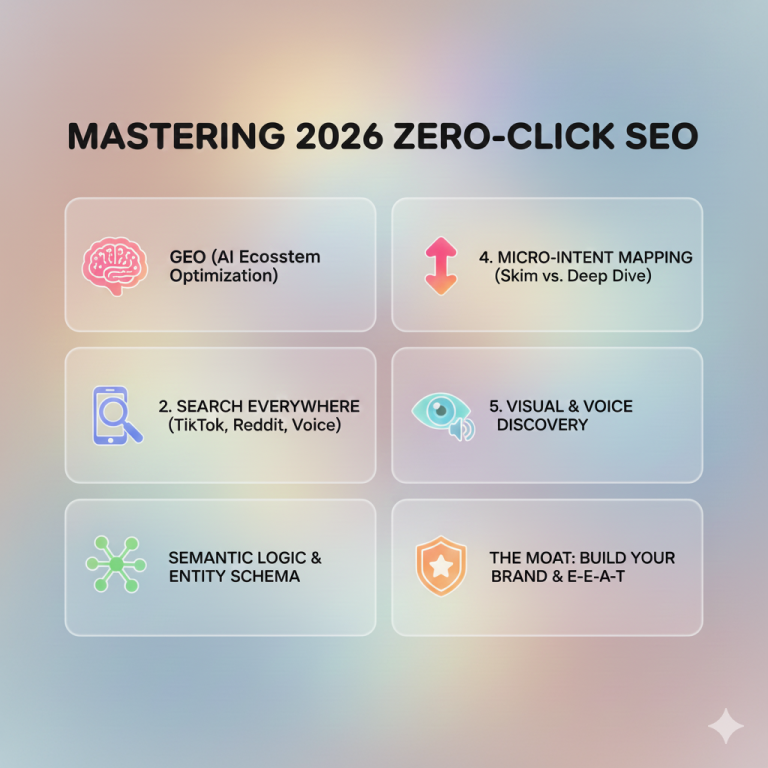
To survive this shift, your SEO strategy can no longer be about just "ranking." It must be about visibility, authority, and presence. Here are the five research trends you need to master to stay ahead of the curve.
1. Optimizing for the AI Ecosystem (GEO)
Search Engine Optimization has evolved into Generative Engine Optimization (GEO). Instead of just ranking for a keyword,
you need to be the source that AI models cite in their summaries.
How to Get Cited by AI
Direct Answer Syntax: Structure your opening paragraphs to answer "What is..." or "How to..." questions in 2-3 concise sentences.
Data-Backed Claims: AI models prioritize unique data. Original surveys or case studies are more likely to be cited than recycled
information.
2. The Rise of "Search Everywhere" Strategy
In 2026, search doesn't just happen on Google. A significant portion of product and information discovery happens on social
search (YouTube, Instagram, TikTok) and Reddit.
Breaking Down Social Search
Keyword Intent on Social: Research what users are asking in comment sections, not just keyword tools.
Platform-Specific SEO: Optimize your video captions and hashtags as if they were Meta Tags.
3. Advanced Technical Schema & Semantic Logic
Search engines no longer just read your text; they try to understand the relationships between entities. This is where high-level
technical SEO becomes your competitive advantage.
How to Implement FAQ and Entity Schema
- Identify Entities: Use tools to identify the primary "entities" (people, places, concepts) in your article.
- Deploy JSON-LD: Use structured data to explicitly tell Google how your content connects to these entities.
- FAQ Schema: 1. Identify the top 3-5 questions users ask about your topic. 2. Use a Schema Generator to create the JSON-LD code. 3. Nest it in the <head> of your page to increase your chances of appearing in "People Also Ask" box
4. User Intent 2.0: Beyond Informational vs. Transactional
The old categories are too broad. In 2026, we look at Micro-Intents. Is the user looking for a quick "In-and-Out" answer, or are they
looking for a "Deep Dive" comparison?
Mapping Content to Micro-Intent
- The "Skimmable" Layer: Use bullet points and bold text for the fast-answer seeker.
- The "Expert" Layer: Use long-form analysis and whitepapers for the deep-researcher.
5. Visual and Voice-First Discovery
With the integration of smart glasses and advanced voice assistants, visual and auditory SEO is mandatory.
Optimizing for Non-Text Search
Visual Search: High-resolution, original images with descriptive Alt Text allow you to rank in Google Lens.
Conversational Keywords: Optimize for long-tail, natural language phrases that people actually speak rather than type.
Conclusion: Brand as the Moat
As AI-generated content floods the internet, the "cost of production" for information has dropped to zero. In this environment, Brand is
the only moat. Trust, lived experience, and a proven reputation—captured in the E-E-A-T (Experience, Expertise, Authoritativeness,
Trustworthiness) framework—are the only things AI cannot easily replicate. Your goal in 2026 isn't just to rank for a keyword; it’s to
build a brand so authoritative that users ask for you by name, and AI models have no choice but to trust your data.
.